
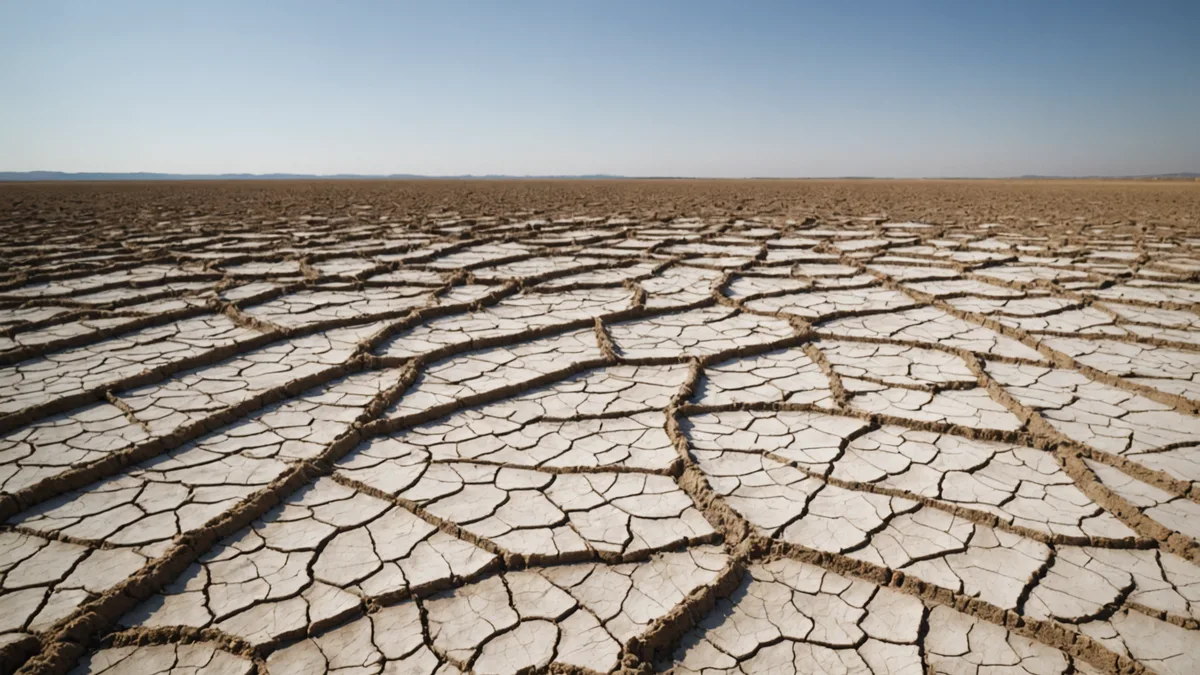
Secondary salinization, the salt accumulation caused by irrigation rather than primary geological processes, is one of the slower-moving agricultural problems in the global system and one of the harder ones to reverse once established. The chemistry that creates it is well understood. The politics and economics that perpetuate it are also well understood. What is less well appreciated is the interaction between existing salinization trends and the changes in evapotranspiration and water balance that accompany warming temperatures, and what that interaction implies for irrigated land in semi-arid grain-producing regions over the next two to three decades.
This piece is a survey of the problem at the scale we care about as a research group, not a comprehensive global analysis. We focus on the soil chemistry, the climate interaction, and the scale in the regions most relevant to our work in South American agriculture.
How Secondary Salinization Accumulates
Irrigation water always contains dissolved salts, even when it comes from sources that appear fresh. Rivers carrying snowmelt from mineral-rich mountain ranges carry measurable salt loads; groundwater tapped from sedimentary aquifers can carry substantially higher ones. The salt concentration is typically low enough that the water qualifies as suitable for irrigation by standard metrics. The problem is that when you apply enough water to a field to meet crop evapotranspiration demand, the water evaporates and transpires and the salt stays behind. Over years and decades of irrigated cropping, salt accumulates in the topsoil, particularly in fields without adequate drainage to move the salt load below the root zone.
The rate of accumulation depends on irrigation water quality (electrical conductivity of the source water), irrigation volume, drainage infrastructure, soil texture (clay soils drain slower and accumulate salts more than sandy soils), and the evaporation demand of the environment. In hot, dry semi-arid conditions, evaporation demand is high, which means a larger fraction of applied water evaporates rather than percolates, which means faster relative salt concentration in the root zone per unit of water applied.
In many irrigated areas of the world that were developed for agriculture during the mid-twentieth century, drainage infrastructure that was designed for the hydrology of that era is now inadequate for higher irrigation volumes driven by higher crop water demands, or was never built adequately to begin with because drainage investment has much lower immediate returns than irrigation infrastructure. The result is a chronic water table rise in irrigated lowlands that brings saline groundwater into the root zone from below, adding a second salt source to the one accumulating from the top.
Where Climate Interaction Compounds the Problem
The interaction between secondary salinization trends and climate change operates through several pathways. The most direct is evapotranspiration demand: warmer temperatures increase the vapor pressure deficit between the leaf surface and the surrounding air, increasing crop water demand. More irrigation is needed to maintain the same soil water content for a given crop, which means more water applied and more salt left behind per growing season. This is the most straightforward amplifier of existing salinization trends.
A second interaction involves precipitation patterns. Many semi-arid agricultural regions depend on rainfall to provide a periodic leaching event that moves accumulated salts below the root zone. If precipitation during the fallow season decreases or becomes more irregular, the salt load that does not get leached continues to accumulate. Conversely, in some regions where precipitation patterns shift toward more intense events separated by longer dry intervals, heavy rainfall after dry periods can cause waterlogging that raises the water table and brings deep saline groundwater closer to root depth, adding to the salt load from below.
There is also an indirect effect through grower response to weather variability: when farmers face unpredictable rainfall timing, they tend to increase irrigation volumes as a buffer, increasing total salt input to the system.
The Situation in South American Irrigated Agriculture
Argentina, the country most relevant to our work, has significant irrigated agricultural area concentrated in the Cuyo region (Mendoza, San Juan, San Luis provinces) and northwestern provinces including Salta and Tucuman. These are semi-arid or arid regions where agriculture is entirely dependent on irrigation from Andean snowmelt rivers or groundwater. Salinization in parts of the Cuyo irrigated lowlands is a documented chronic problem in the agronomy literature: the combination of alluvial soils with poor natural drainage, high evaporation demand, and older irrigation infrastructure creates the conditions described above.
Patagonian agriculture is geographically distinct: it is concentrated in river valley systems (principally the Rio Negro, Neuquen, and Limay basins) where snowmelt irrigation from Andean sources has supported fruit and vegetable production for over a century. These valleys also have documented soil salinization issues in the lower valley sections, where drainage from higher irrigated zones concentrates salt. The combination of existing salt accumulation in these valleys with projected temperature increases of 1.5-2C under moderate warming scenarios means the evapotranspiration demand increase will further stress soils that already sit at marginal salt tolerance ranges for the crops grown there.
The Current Toolkit and Its Limits
The established management approach for irrigated saline soils combines leaching fractions (applying more water than evapotranspiration requires to push salt below the root zone), gypsum applications to replace exchangeable sodium with calcium and restore soil structure, and drainage improvement to facilitate salt removal below the root zone. These approaches work when they can be implemented fully: drainage construction is expensive, leaching fractions increase water consumption in regions where water is already a limiting resource, and gypsum effects require years of consistent application before soil structure visibly recovers.
None of these approaches addresses the underlying problem of continued salt input through irrigation. They manage the symptom. In regions where salinity is at 4-8 dS/m and likely to increase, the management approach effectively requires an endless escalation of reclamation inputs to stay ahead of ongoing accumulation. For many growers, particularly those without access to capital for drainage infrastructure or without water allocations large enough to run meaningful leaching fractions, this is not a viable long-term position.
Where Biostimulants Fit This Problem
We are not claiming that biostimulants solve soil salinization. They do not. The salt accumulation problem is a land and water management problem that requires structural solutions. What we are saying is that there is a large category of land that will continue to carry salt loads in the 4-12 dS/m range for the foreseeable future, regardless of what management practices improve at the margins, and that this land currently produces reduced yields from stress effects that a well-characterized microbial treatment might partially mitigate.
The target is not perfect soil but marginal land that can be kept productive while management improvements happen on a longer timeline. That is a real and defensible application space for stress-tolerant biostimulants, and it is the honest framing of what we are building toward. We are not a replacement for drainage investment or better water policy. We are a tool for maintaining crop productivity on land that will be stressed regardless of those policy choices in the near term.