
People ask what our discovery process looks like, and the honest answer is that it involves a lot more dead ends and backtracking than any pipeline diagram suggests. The linear progression from "soil sample" to "candidate strain" that we show on the website reflects the logic of the process, not the daily reality of it. What actually happens involves multiple rounds of culturing, genomic analysis, phenotypic testing, and decision points where we decide a strain that looked promising does not warrant further resources.
This walkthrough covers the actual steps, including the ones that fail, from a field collection in a hypersaline Patagonian laguna environment to a greenhouse assay that tells us something worth knowing.
Step 1: Site Selection and Field Collection
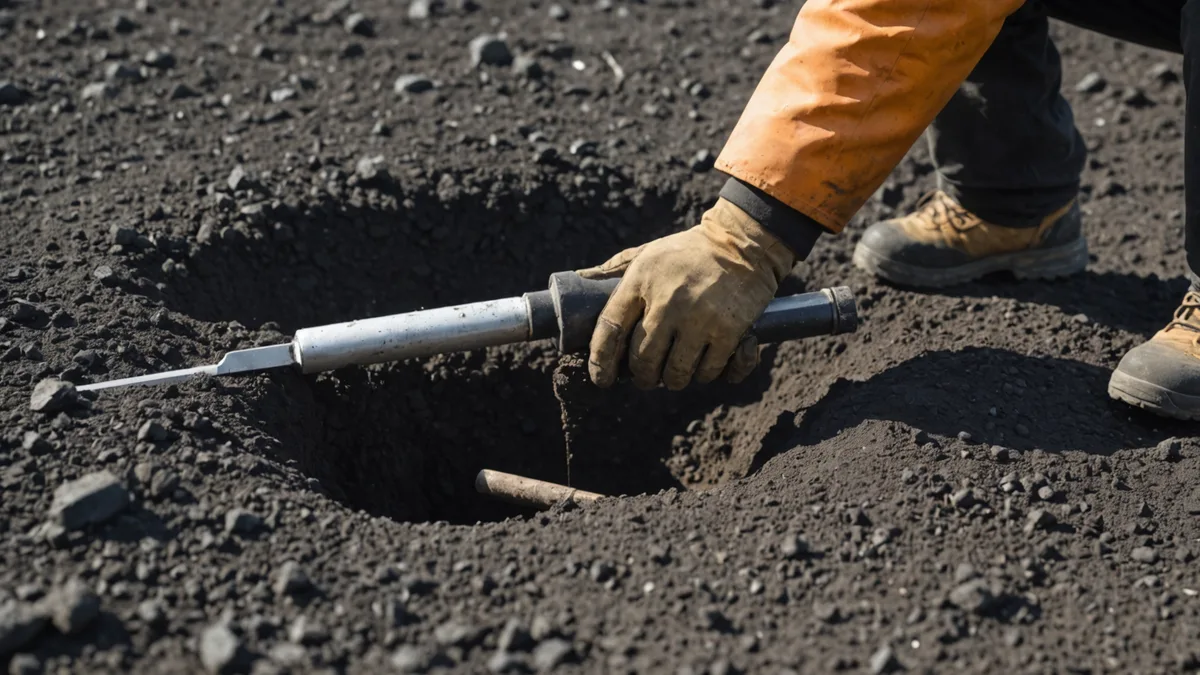
We do not collect from random locations. The site selection protocol starts with a hypothesis about which environmental conditions are most likely to select for stress-tolerance mechanisms that are agriculturally relevant. For salinity candidates, we target sites where salt accumulation has been stable over multiple seasons, not sites with occasional salt influence. The reasoning is that persistent high salinity selects for organisms whose primary physiology is adapted to osmotic stress, not organisms that happen to survive an occasional saline incursion and then return to normal metabolic mode when conditions ease.
Hypersaline laguna margins in northern Patagonia are a preferred collection type. These environments have electrical conductivity values that can exceed 80-100 dS/m in the dry season at the edge zones, with strong gradients as you move away from the water line. We collect samples at multiple positions along the salinity gradient: the highest-salinity zone near the water line, intermediate transition zones, and the outer margin where conductivity drops to 10-20 dS/m. This gradient design lets us isolate organisms from each salinity regime and later compare their stress-tolerance profiles.
Collection logistics at these sites are not trivial. Many are several hours of driving from the nearest town on unpaved roads at altitude. The protocol requires keeping samples cold and at near-ambient humidity from collection to first culturing, which in the field means insulated containers and careful sample handling, with the first plating step happening within 24-48 hours of collection at a local partner facility or, if unavoidable, under field conditions.
Step 2: Initial Culturing and Isolation
From each soil sample, we prepare serial dilutions in saline buffer matched to the collection site conductivity and plate on R2A agar with added NaCl at concentrations relevant to our target. This selective pressure approach means we are enriching for organisms that grow under high salt, not just organisms that survive on a standard laboratory medium. The tradeoff is that we almost certainly miss organisms that cannot grow on any culture medium, which is a known limitation of culture-dependent methods.
Colony morphology on the initial plates gives a first rough diversity read. We pick colonies representing different morphologies, size classes, and growth rates, because morphological diversity at this stage is a rough proxy for taxonomic diversity. We do not assume that the dominant colony type in a plate is the most interesting one: sometimes the rarest colony morphology at high salinity turns out to carry the most unusual gene content. We maintain the archive broadly rather than narrowing at this stage.
Pure cultures go through a liquid enrichment step at defined salt concentrations to confirm growth and establish working stocks. Glycerol stocks go into the archive at -80C. Anything in the archive can be retrieved later if our analytical criteria change; we do not throw anything away at this stage.
Step 3: Genomic Sequencing and Annotation
Batches of 50 to 100 isolates go forward to DNA extraction and genome sequencing. We make allocation decisions based on initial phenotypic profiling: isolates that show growth on NaCl-amended media above our threshold concentration, or that show unusual colony characteristics suggesting unusual physiology, get prioritized in each sequencing batch. Isolates that grow only at low salinity concentrations on the first pass are not immediately deprioritized (the cold-stress mechanism from a chilling-tolerance perspective does not require halotolerance), but they are placed in a lower-priority queue relative to the ones that demonstrate the tolerance we are specifically looking for.
After assembly and annotation, each genome goes through our gene family scoring pipeline. Valentina described the AI screening layer in a previous post, so I will not repeat the technical detail here. What I will add from the workflow perspective is that the genomic scoring step is where the first significant filtering happens: roughly 60-70% of isolates that make it to sequencing do not show enough gene content of interest to justify phenotypic assay resources. They go back into the archive, annotated and scored, available for retrieval if a new gene target becomes relevant later.
Step 4: Phenotypic Validation of High-Priority Isolates
Isolates in the top tier from genomic scoring go through a battery of phenotypic tests before any plant involvement. This includes quantitative salt tolerance assays (minimum inhibitory NaCl concentration, growth curve at multiple salt concentrations), ACC deaminase activity via the standard spectrophotometric assay, phosphate solubilization capacity on Pikovskaya's medium, IAA production detected by the Salkowski reagent method, and biofilm formation on surfaces to estimate EPS production capacity.
Each of these assays has its own pass/fail threshold for advancement. We run all assays in parallel rather than sequentially to avoid spending time on a strain that would have failed an early filter. The phenotypic results often diverge from the genomic prediction in informative ways: a strain with a complete ect gene cluster sometimes shows no ectoine in the growth medium, suggesting the cluster is not expressed under our lab conditions even though it is genomically present. These discordances are noted and the strain's priority is adjusted accordingly.
Step 5: Root Colonization and Plant Assays
Strains that pass the phenotypic battery go into root colonization assays with the crop species we are targeting. This is the first point at which the question is not "what can this bacterium do in culture" but "what does it do to a plant." The assay protocol involves surface-sterilized seeds inoculated with a defined concentration of the candidate strain, grown in sterile growth medium under defined temperature and light conditions, and evaluated at 7 and 14 days post-germination for root length, lateral root density, and fresh weight relative to uninoculated controls.
The salt-stress version adds a defined NaCl concentration to the growth medium to assess whether the PGP effect is present specifically under stress conditions. Some strains show positive root effects in the no-stress control but no effect or even a negative effect under the NaCl treatment. We do not advance those. We need the beneficial effect to be present under the stress condition, not just under optimal conditions where the plant does not need the help.
From This Process to NB-001
NB-001 went through this entire sequence, from collection at a hypersaline laguna edge site with conductivity above 50 dS/m, through genomic scoring that placed it in the top tier for halotolerance plus ACC deaminase gene content, through phenotypic confirmation of ACC deaminase activity and phosphate solubilization, to root assays in both wheat and soybean seedlings under 100 mM NaCl treatment where it showed measurably longer root systems and improved lateral root density compared to uninoculated stressed controls. That is the basis on which it is now in greenhouse validation. The pathway took several months from collection to greenhouse entry, which is not fast, but it is the pace that the biology requires.
We are not building a screening factory. We are building a sufficiently rigorous process that when something reaches greenhouse stage, we have reasonable confidence that the effect we are looking for is real and mechanistically grounded. That confidence is what makes the field trial investment worth making.