
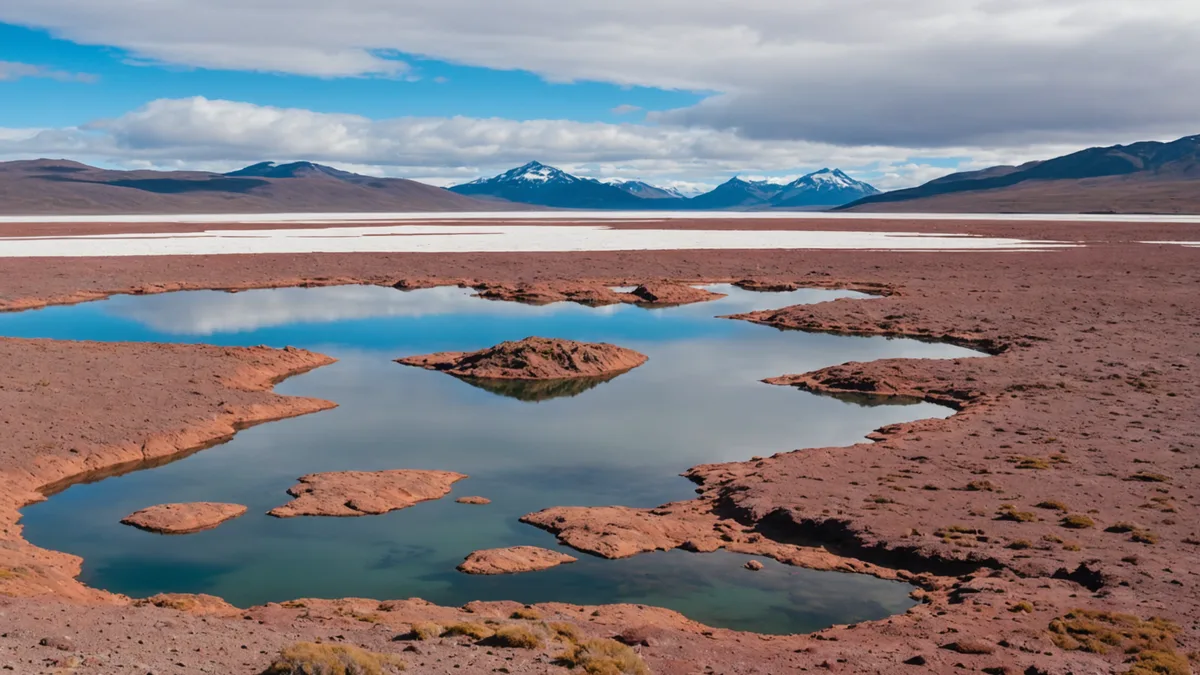
The name Nunatak refers to the exposed rock peaks that protrude above glacial ice sheets, the only surfaces available for life to colonize in otherwise inhospitable frozen terrain. When Pablo, Valentina, and I were deciding what to name this company, that image felt right: organisms surviving in what appears to be a completely hostile environment, finding a way to persist and sometimes to thrive. The field collection choice came from the same reasoning. Patagonia was not an arbitrary starting point.
This piece is about why Patagonian extreme environments were the deliberate scientific starting point for our work, and what we expected to find versus what we actually found when we got into the field.
The Problem We Are Trying to Solve Drove the Sampling Choice
We built Nunatak Biotech to discover microbial biostimulants for stressed agricultural soils. Not productive soils with minor nutrient deficiencies, but soils that are genuinely hostile to crops: high electrical conductivity from secondary salinization, cold growing seasons in high-altitude or southern-latitude farming zones, poor soil structure from compaction and organic matter loss, and low biological activity from the compound effects of all of the above. The Argentine agricultural landscape has all of these challenges represented, from the degraded irrigated valleys of Mendoza and San Juan to the cold high-altitude growing zones in Jujuy and Salta to the frost-exposed farming areas of the Pampa Austral.
Once you define the problem that way, the sampling logic becomes straightforward. You want organisms that are pre-adapted to the conditions you are trying to help crops survive. Not organisms that grew up in a comfortable temperate soil and will be exposed to salinity or cold for the first time when you apply them to a stressed field. Organisms that have been living in those conditions continuously, for many generations, and have developed constitutive physiological solutions to the problems the conditions create.
Patagonia has, within accessible distance from research infrastructure in Argentina, environments that match the stress profiles of the agricultural problems we care about. Cold steppe soils with seasonal frost. Salt flats and salt-flat margins with conductivity values that kill conventional crops. Volcanic soils with low organic matter and high wind desiccation. And in the Andean foothills, soils that combine cold, salinity, and poor structure simultaneously. If we could find organisms that are active and growing in those environments, we would have strong a priori reason to think their stress-tolerance physiology is real and constitutive, not induced.
What We Expected to Find
Before the first field expedition, we did a literature survey of what was known about microbial communities in Patagonian soils. The answer was: not much, at least not at the genus and species level of detail relevant to agricultural application. There were broad-brush studies of Patagonian steppe soils showing Actinobacteria and Firmicutes dominance, some work on high-altitude volcanic soils, a handful of papers characterizing halophiles from specific saline lakes. Nothing that gave us a clear picture of the cultivable halotolerant and psychrotolerant organisms that would be present in the soil types we were targeting.
We expected to find stress-tolerant organisms. We expected to find a different community profile than temperate agricultural soil surveys would predict. We expected some percentage of our isolates to carry PGP gene content, because PGP trait genes are widespread in soil bacteria generally. We were less certain about what fraction would combine halotolerance with PGP activity at levels that would be agronomically meaningful.
What the First Field Collection Produced
The first expedition covered three sites in Neuquen and Rio Negro provinces: a salt flat margin near a playas lake system, a high-altitude (1,800m) volcanic steppe site above San Martin de los Andes, and a seasonally flooded lowland site in the Rio Negro valley that had been subject to irrigation-driven salinization over several decades of fruit production.
We collected approximately 45 liters of soil across the three sites, processed into 6 distinct sample batches covering different depth horizons and microhabitat types. Back in the laboratory in Buenos Aires, we processed to primary isolates through dilution plating and selective media designed for halotolerant and psychrotolerant organisms. The first genomic screening batch covered 80 isolates.
The hit rate for combined halotolerance and PGP gene content was higher than our baseline expectation. Roughly 35% of the 80 isolates showed genomic scores suggesting halotolerance plus at least one PGP function. That is substantially higher than the 10-15% rate we would expect from isolates taken from temperate agricultural soils based on the published literature. The phenotypic confirmation work reduced that number considerably, as it always does: many genomic predictions do not survive the phenotypic assays. But the starting pool was richer than what we would have gotten from a convenience sample.
The volcanic steppe site produced organisms we were not expecting: several isolates from an Actinobacteria lineage with unusual cold-tolerance combined with phosphate solubilization activity, showing growth down to 4 degrees C on Pikovskaya's agar. Those have become the early candidates for what is now NB-002 in our pipeline, targeted at cold-stress applications for maize and potato. We did not design the first expedition with the intention of finding cold-tolerant PSB specifically; we found them because the volcanic steppe environment selects for exactly that combination.
What Working in Patagonia Actually Looks Like
There is a logistical reality to extreme-environment field collection that does not feature in the published papers that describe it. The access logistics for the sites we sample are not trivial. The salt flat margin site we use requires a four-hour drive from the nearest city on roads that are poorly maintained and subject to seasonal closures. The high-altitude volcanic site is reachable only in late spring through early autumn because snow closes the access road for six months. The Rio Negro valley site is more accessible but requires coordination with the property owner for each expedition.
Sample preservation in the field and during transport requires careful attention. We pack soil samples in sterile containers with desiccant packs and keep them at controlled temperature during the drive back to Buenos Aires. Time from collection to laboratory processing matters for cultivable organism recovery; we aim to get samples into primary dilution plating within 48 hours of collection. This constraint shapes our expedition planning as much as any scientific consideration.
We have also learned to pay attention to microhabitat heterogeneity within a single collection site. Two sampling points separated by ten meters can produce substantially different community profiles if one is in the rhizosphere shadow of a sparse shrub and the other is bare soil. We sample both types systematically now, with GPS coordinates for each point, so we can link back to the microhabitat context when we analyze our genomic data. Early expeditions were less systematic about this and we have some collection batches where we cannot reconstruct the exact microhabitat of origin.
Is Patagonia the Only Place We Should Sample?
No. It is a strong starting point for the specific problem profile we chose to focus on, and it is accessible from Argentina in a way that equivalent environments elsewhere are not. But the stress-tolerant microorganism reservoir is distributed globally: Atacama Desert margins, Tibetan Plateau agricultural soils, saline steppes in Central Asia, salt-affected agricultural soils in the Nile Delta and the Indus valley. Any of these would produce organisms worth screening for the kind of combined halotolerance and PGP profiles we are looking for.
We chose Patagonia because it is local, it represents the stress profiles relevant to Argentine agriculture specifically, it was accessible for a small group starting with limited resources, and no one had done systematic cultivable isolate collection from the specific sites we targeted. Those are practical reasons, not claims that Patagonia is uniquely superior as a microbial reservoir. The scientific principle, that extreme-environment selection pressure produces relevant stress-tolerance physiology, applies wherever those environments exist.
As we develop into later stages, we expect to expand the geographic scope of collection to build a more complete picture of the diversity available. For now, Patagonian collections are our core material, and they have already produced candidates that we consider real development prospects. That justifies the choice we made at the start.